
Have you ever wondered if simply owning a Quran, or reading it once in a while, is really enough? Islam teaches us that the Quran has real rights over every Muslim, things we owe back to it, not just things we take from it.
The rights of the Holy Quran over Muslims are to believe in it as Allah’s word, recite it regularly and correctly, listen to it with attention, understand its meaning, reflect on its teachings, follow its guidance in daily life, and learn, teach, and share it with others. Together, these seven rights turn the Quran from a book on a shelf into a living part of daily life.
In this article, we’ll go through each of these seven rights in simple words, along with practical ways to actually live them out.
7 Important Rights of the Holy Quran Over Muslims
1. Believe in the Holy Quran as the Word of Allah
The first right of the Quran on us is simple, but foundational: truly believing it is the word of Allah, revealed to Prophet Muhammad (peace be upon him) . This belief is a core part of a Muslim’s faith, not just a formality. It means accepting its guidance with full sincerity, not picking and choosing only the parts that feel comfortable.
Allah describes this clearly in the Quran: (Surah Al-Baqarah, 2:2)
ذَٰلِكَ الْكِتَابُ لَا رَيْبَ ۛ فِيهِ ۛ هُدًى لِّلْمُتَّقِينَ
Translation: This is the Book, free of doubt, a guidance for those mindful of Allah
This verse reminds us that the Quran isn’t meant to be approached with doubt or hesitation, it’s meant to be received as clear guidance.
2. Recite the Holy Quran Regularly and Correctly
Reading the Quran shouldn’t be something that only happens occasionally, on special nights or during Ramadan. Setting aside even a small amount of time daily, even just a few verses, keeps your connection with the Quran alive.
Correct pronunciation matters here too. Learning proper Tajweed isn’t an optional extra, it’s part of reciting the Quran the way it deserves to be recited. We’ve explained this more in our article on the importance of Tajweed, if you’d like to understand why it matters so much. If you’re a beginner, this is exactly where guided practice with a qualified Quran teacher makes a real difference, someone who can correct small mistakes before they become habits. And importantly, you shouldn’t wait until you’re fluent to start, keep practising even while you’re still learning.
Allah says: (Surah Al-Muzzammil, 73:4)
أَوْ زِدْ عَلَيْهِ وَرَتِّلِ الْقُرْآنَ تَرْتِيلًا
Translation: Recite the Quran slowly, with care.
This instruction to recite slowly and clearly is exactly what Tajweed training is built around.
3. Listen to the Quran with Respect and Attention
How many times have we been in a room where the Quran is playing, maybe from a speaker, a phone, or someone reciting nearby, and we just carry on talking, scrolling, or doing something else, without really listening at all? It happens to the best of us. But listening carefully when the Quran is being recited is itself an act of respect, not just a nice gesture.
This means putting away the distractions for a moment, avoiding unnecessary talking, and actually paying attention, rather than letting the recitation fade into the background like noise.
Allah tells us: (Surah Al-A’raf, 7:204)
وَإِذَا قُرِئَ الْقُرْآنُ فَاسْتَمِعُوا لَهُ وَأَنصِتُوا لَعَلَّكُمْ تُرْحَمُونَ
Translation: When the Quran is recited, listen to it and be silent.
4. Understand the Meaning of the Holy Quran
Reciting the Quran in Arabic is rewarding on its own, even if you don’t understand every word yet. But once you understand what you’re actually saying, your connection to the Quran becomes so much deeper.
A good place to start is reading a simple, reliable translation in a language you understand well. After that, Tafseer helps you go even further, it explains the background and deeper meaning behind a verse, so you understand not just what it says, but why it was revealed. And if a verse ever feels confusing, don’t guess, and don’t trust just any random explanation online. Ask a qualified teacher who actually knows.
If you’ve been reciting the Quran for years but still feel unsure about what it truly means, you’re not alone, and you don’t have to figure it out by yourself. Mairaj Ul Quran has trained over 10,000 students, and our teachers can guide you step by step through translation and Tafseer, at your own pace, so the Quran finally makes sense the way it was always meant to.
5. Reflect on the Quran and Apply Its Teachings
This right is known as Tadabbur, taking a moment to genuinely think about what a verse is teaching, rather than reading past it quickly. Reflection is what turns reading into real benefit. A verse about patience, for example, means little if it’s never connected to an actual moment of patience in your own life.
Allah asks: (Surah Muhammad, 47:24)
أَفَلَا يَتَدَبَّرُونَ الْقُرْآنَ أَمْ عَلَىٰ قُلُوبٍ أَقْفَالُهَا
Translation: Do they not reflect upon the Quran, or are there locks upon their hearts?
And elsewhere: (Surah Sad, 38:29)
كِتَابٌ أَنزَلْنَاهُ إِلَيْكَ مُبَارَكٌ لِّيَدَّبَّرُوا آيَاتِهِ
Translation: A blessed Book, revealed so that people may reflect upon its verses.
A simple example: reading a verse about honesty, then actually pausing to think about a moment that week where you could have been more honest, turns a verse from words on a page into something lived.
6. Follow the Guidance of the Holy Quran in Daily Life
The Quran isn’t meant to just sit in our hearts as belief, it’s meant to show up in how we actually live and behave. This means being honest in our dealings, being fair, being kind to our parents, keeping our promises, helping the people around us, and staying away from wrongdoing.
One important thing to remember here, never take just one verse on its own and build a ruling out of it without understanding its proper context. Always learn the full picture first. This guidance touches so much of our everyday life, how we treat our family, how we run our business, and how we treat our neighbours.
Allah says: (Surah Al-An’am, 6:155)
وَهَٰذَا كِتَابٌ أَنزَلْنَاهُ مُبَارَكٌ فَاتَّبِعُوهُ وَاتَّقُوا
Translation: This is a blessed Book, so follow it and be mindful of Allah.
Learning and practising really do need to go together, knowledge without action, and action without knowledge, both fall short of what the Quran asks of us.
7. Learn, Teach, and Share the Message of the Holy Quran
The last right is simple, pass the Quran forward. This starts with us learning from qualified teachers ourselves, so we’re learning the right way, from the right people. Then it moves to teaching our children, gently and in a way that fits their age, how to read the Quran and respect it. Sharing what we learn with our family and others is part of this too, but it comes with a responsibility, never sharing a quote or an explanation you haven’t actually checked is correct.
Allah tells us: (Surah An-Nahl, 16:125)
ادْعُ إِلَىٰ سَبِيلِ رَبِّكَ بِالْحِكْمَةِ وَالْمَوْعِظَةِ الْحَسَنَةِ
Translation: Invite to the way of your Lord with wisdom and good instruction.
Whenever we share knowledge, it should always come with wisdom, kindness, and humility, never with pressure or arrogance.
Together, these seven rights give us the full picture: belief, recitation, listening with attention, understanding, reflection, action, and teaching.
How Can Muslims Fulfil the Rights of the Quran in Daily Life?
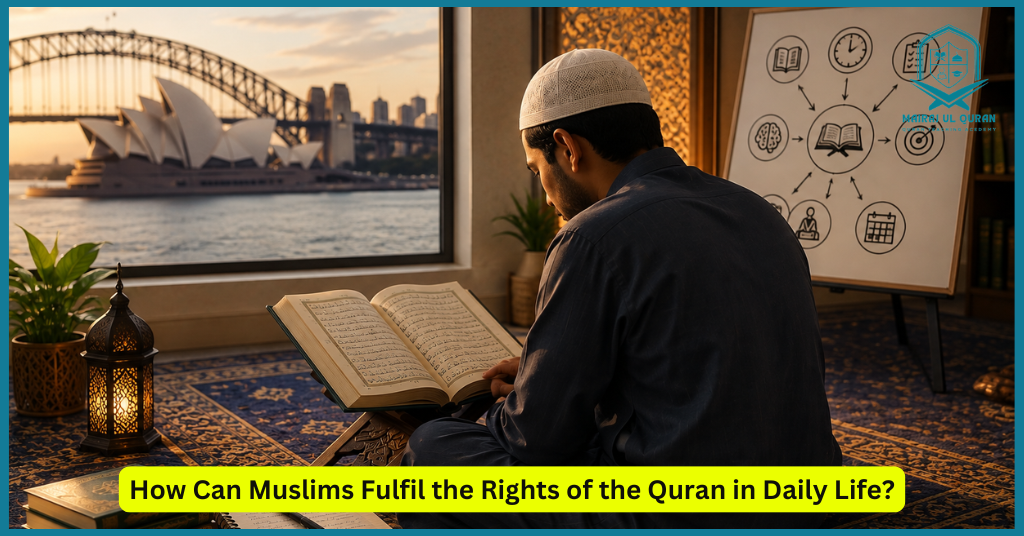
Living out these rights doesn’t require huge changes overnight. A few practical steps help:
- Set a realistic daily Quran reading routine, even five or ten minutes counts
- Learn a few new words or meanings at a time, rather than trying to understand everything at once
- Read a trusted translation alongside your recitation
- Study Tafseer with reliable guidance, not random online sources
- Choose one teaching to actually practise each day
- Encourage family members to learn together, it keeps everyone motivated
- Review your progress weekly, rather than setting goals that are unrealistic from the start
Common Mistakes Muslims Should Avoid When Fulfilling the Rights of the Quran
- Reciting regularly but never really trying to understand what it means
- Focusing only on making recitation sound beautiful, while ignoring correct pronunciation
- Keeping a Quran at home but barely ever opening it
- Sharing Quranic quotes without checking if they’re actually accurate or correctly understood
- Explaining verses without having enough knowledge to do it properly
- Teaching children through pressure, instead of patience and gentle encouragement
- Thinking that respecting the physical Mushaf is enough, without actually practising what it teaches
One thing worth saying clearly: reciting the Quran is valuable and rewarded on its own, even if you’re still learning what it means. None of this is meant to make a beginner feel discouraged, it’s simply meant to gently push all of us to keep growing from wherever we currently are.
How Parents Can Teach Children the Rights of the Holy Quran
- Help children build a regular, simple Quran reading habit
- Teach them to handle the Mushaf with care and respect
- Explain short Surahs in simple, age-appropriate language
- Help them connect Quranic teachings to honesty, kindness, and good manners in daily life
- Use encouragement and small, achievable goals, rather than pressure
- Arrange proper Quran lessons when a child needs extra support with reading or Tajweed
How Learning with a Qualified Quran Teacher Can Help
A qualified teacher genuinely changes how far someone can go with the Quran. A good teacher helps improve pronunciation and recitation, teaches the rules of Tajweed step by step, explains selected verses through reliable sources rather than guesswork, answers questions when something feels unclear, and helps build a consistent, realistic learning routine for children and adults alike, each progressing at their own pace.
This is exactly the kind of support we focus on at Mairaj Ul Quran. Our teachers work with students who want to genuinely improve their Quran reading, Tajweed, and overall understanding, through structured, one-on-one classes, along with a free trial class so you can see our teaching style before committing to anything.
Conclusion
The rights of the Holy Quran over Muslims come down to seven simple but meaningful commitments: believing in it, reciting it correctly, listening to it attentively, understanding its meaning, reflecting on its message, following its guidance, and passing it on to others. A real, lasting connection with the Quran isn’t built on just one of these alone, it grows from all seven working together.
You don’t need to master everything at once. Start with one small, manageable step today, maybe that’s five extra minutes of recitation, or finally reading a translation alongside the Arabic you already know.
We’d love to hear which of these you want to work on first. And if you’d like guided support with your Quran journey, reach out to Mairaj Ul Quran today, we’re here to help, one step at a time.