
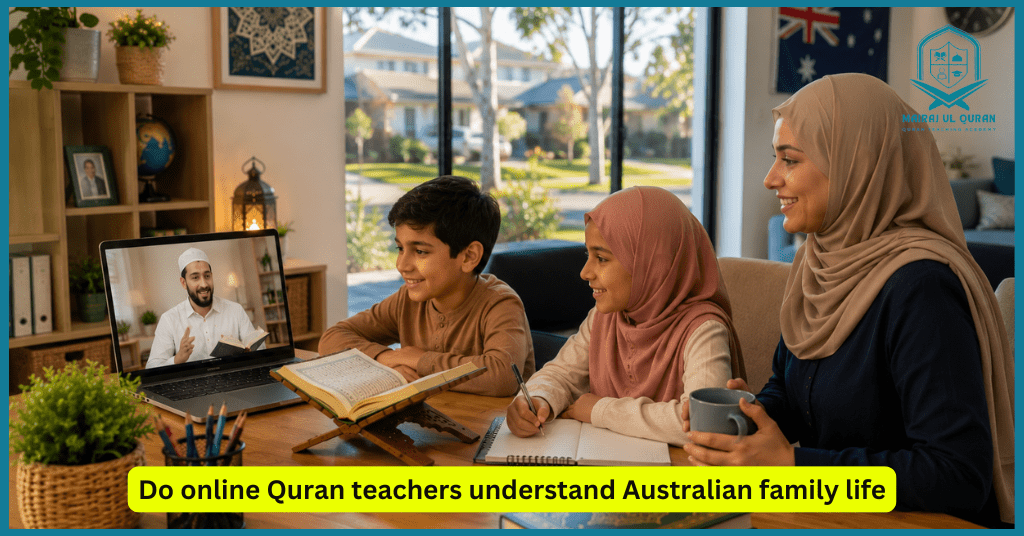
If you’ve ever tried booking an online Quran class only to find the timing clashes with school, homework, or your child’s bedtime, you’ve probably asked yourself this question.
Yes, online Quran teachers can understand Australian family life, but only if the academy actually pays attention to it. A good teacher asks about your child’s school routine, respects homework and bedtime, adjusts class timing around your week, and communicates clearly with parents, instead of expecting every family to fit the same fixed schedule.
Here in this article, we’ll look at what “understanding Australian family life” really means for a Quran teacher, and how you can tell if the academy you’re considering genuinely gets it, or is just saying the right words.
What Is Different About Muslim Family Life in Australia?
Every family is different, so it’s hard to say one single thing describes all Muslim families in Australia. But there are a few patterns that come up again and again for a lot of families here, and they’re worth understanding before picking a Quran teacher.
School and Homework Come First During the Week
For most families, weekdays revolve around school. Kids are usually in class from around 9am to 3pm, followed by homework, and sometimes exams that need focused study time. On top of that, many children have after school activities, sport practice, tutoring, or other commitments. Every family’s routine looks a little different depending on the child’s age, school, and personality, but weekday afternoons and evenings are rarely wide open.
Parents Have Busy Work and Family Schedules
Parents are juggling a lot too. Many are working, often with a commute added on either side of the day. If there are younger siblings at home, that adds feeding, bath time, and bedtime routines into the mix. By the time household responsibilities are done in the evening, energy is often running low, for parents and kids alike.
Weekends Are Often Already Busy
Weekends aren’t necessarily easier. Between sport games, family visits, community events, grocery shopping, errands, and sometimes Islamic activities like weekend Islamic school, many families have very little genuinely free time even on a Saturday or Sunday.
Can an Online Quran Teacher Understand an Australian Child’s Routine?
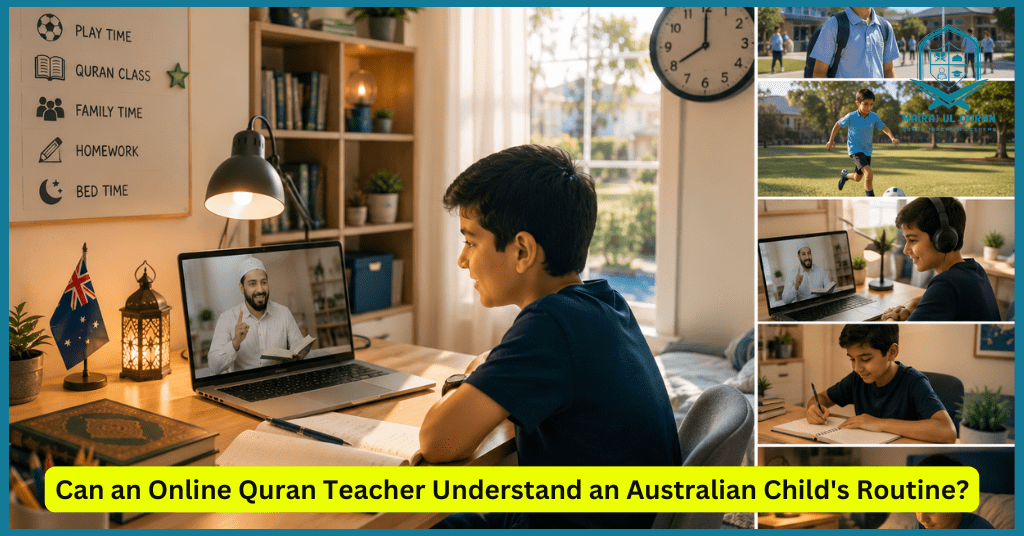
Yes, but only if the teacher is actually paying attention to it, rather than teaching every student the same way regardless of where they live.
A suitable teacher for an Australian family should:
- Ask about the child’s actual weekly routine before setting a fixed schedule.
- Respect school commitments instead of treating Quran class as more important than everything else.
- Be willing to adjust lesson timing around school, sport, or family routines.
- Understand the child’s age and current level, rather than teaching everyone the same way.
- Avoid putting unnecessary pressure on a child who’s already had a long school day
- Communicate clearly with parents, not just the child.
This is really the core test. It’s not about where a teacher is physically located, it’s about whether they actually adapt to the family in front of them.
What Should an Australian Friendly Quran Teacher Understand?
Australian School Timetables
A teacher who understands Australian school hours will naturally avoid suggesting class times that clash with typical school hours, or that leave no time for homework at all.
Australian Time Zones
Australia isn’t on one single time zone, and a good teacher should know this. Sydney, Melbourne, and Canberra generally sit on the same eastern time, Brisbane sits slightly differently since Queensland doesn’t use daylight saving, Adelaide runs half an hour behind the eastern states, and Perth is a few hours behind everyone else. Families in regional and remote parts of Australia may also have their own scheduling needs depending on distance from major cities.
One detail worth knowing yourself as a parent: NSW, Victoria, the ACT, South Australia, and Tasmania move their clocks forward for daylight saving in summer, while Queensland, Western Australia, and the Northern Territory don’t. This means the time difference between cities actually changes depending on the time of year, not just where they are on a map. A teacher who’s aware of this will double check your local time rather than assuming.
School Holidays and Family Travel
Regular term-time schedules often need to shift during school holidays, whether that’s because of family travel, a change in routine, or simply a child wanting a short break. You can check your state’s official school term dates each year to plan around this properly.
Different Family Backgrounds
Australia’s Muslim community includes families from many different cultural and language backgrounds. A good teacher should be respectful of these differences, rather than assuming every family follows the same customs, language, or expectations.
Why Flexible Quran Classes Matter for Australian Families

This is where flexibility really matters in day to day life, not just as a marketing phrase.
After-School Quran Classes
For many families, a short window right after school, before homework and activities take over, works well.
Evening Quran Classes
Some families prefer a slightly later slot, once dinner and other routines have settled down.
Weekend Quran Classes
For busy weekday households, a fixed weekend slot might genuinely be the only realistic option.
Classes During School Holidays
Some families like continuing lessons through the holidays with a lighter schedule… We’ve covered this in more detail in our guide on how to teach kids Quran during school holidays in Australia.
Make-Up Options When a Child Misses a Lesson
Life happens, sickness, family events, unexpected clashes. It’s worth asking any academy directly what their actual policy is if a class is missed, rather than assuming, since policies vary between academies.
Should Quran Teachers Adjust Their Teaching Style for Australian Kids?
Flexibility in scheduling doesn’t mean lowering the standard of what’s being taught. A good teacher can still maintain:
- Correct Quran pronunciation
- proper Tajweed
- Accurate recitation
- Islamic manners and etiquette
- A structured, step-by-step lesson plan
while also using:
- Age-appropriate explanations that actually make sense to a child
- Patient correction instead of frustration when a child struggles
- Short, focused activities rather than long, tiring sessions
- Positive encouragement to keep the child motivated
- Clear English communication when needed, especially for kids more comfortable in English than Arabic or Urdu
Adjusting how something is taught is not the same as teaching it incorrectly. A skilled teacher can do both at once.
Why One to One Quran Classes Can Work Well for Australian Children
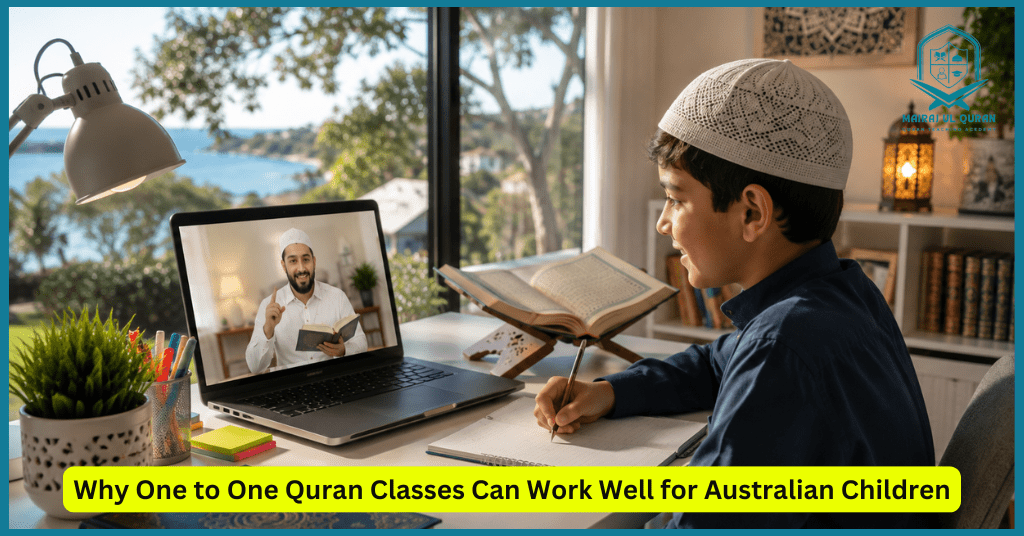
One-to-one classes tend to work really well for busy Australian households. When a teacher is only focused on one child, they can spot mistakes right away and fix them on the spot, instead of missing them in a big group. Lessons can also match exactly what that child needs, not just move at the average speed of the whole class. There’s less pressure too, since the child isn’t reciting in front of a room full of other kids. Parents get the added benefit of talking directly to the teacher about their own child’s progress, and the best part is, the pace can slow down or speed up anytime, depending on how the child is doing that day.
Can an Overseas Quran Teacher Still Understand Australian Families?
This is a fair question, and it deserves an honest answer rather than a dismissive one.
What Matters More Than Where the Teacher Lives?
A teacher’s location matters far less than these things:
- Actual experience teaching Australian students specifically
- A genuine understanding of Australian school and family schedules
- Good, clear English communication
- Respect for each family’s own preferences and background
- Real experience teaching children, not just adults
- Professional conduct throughout every class
- Reliable, consistent communication with parents
A teacher based overseas who ticks all of these can absolutely understand an Australian family’s needs. A local teacher who ignores a family’s routine and communicates poorly would struggle just as much, regardless of location.
How Teachers Can Support Different Australian Muslim Families
Working Parents
Flexible evening or weekend slots, and clear communication that doesn’t require parents to be available during work hours.
Families With Multiple Children
Scheduling that considers sibling routines, rather than treating each child’s timing in isolation.
Regional and Rural Families
Recognising that some families may have less access to local Islamic education options, making online classes especially valuable, and building schedules that work regardless of location.
Families Who Travel During School Holidays
Willingness to pause, adjust, or shift timing around family travel rather than enforcing a rigid schedule.
Families Who Prefer Female Quran Teachers
Offering the option of a female teacher, particularly valued by many families for their daughters.
Children Who Are Complete Beginners
Starting from the very basics, like Noorani Qaida, at a pace that doesn’t rush a first-time learner.
How Parents Can Tell If a Quran Academy Understands Their Family
A simple checklist worth going through before enrolling:
- Do they offer genuinely flexible scheduling?
- Do they understand and accommodate Australian time zones?
- Are their teachers properly qualified?
- Is their teaching style child friendly?
- Do they offer one-to-one classes?
- Do they communicate clearly and regularly with parents?
- Do they track and share your child’s progress?
- Do they offer both female and male teachers?
- Is their pricing clear, with no hidden extras?
- Do they offer a trial lesson before you commit?
- Do they have a reasonable, clearly explained rescheduling policy?
- Do they take online safety seriously?
If most of these are a yes, that’s a strong sign the academy has actually thought about families like yours. You can also read more about why Mairaj Ul Quran is trusted by Australian families here.
What About Safety When Children Learn With an Online Teacher?
Since this involves children, safety deserves real attention, not just a line in a FAQ.
Worth checking for:
- Whether parents can stay involved or sit in on classes if they choose to
- Clarity on the teacher’s identity and qualifications
- Professional, respectful communication at all times
- Appropriate conduct during every online session
- A secure, properly set-up class environment, not just an unregulated video call
- Parents genuinely knowing who is teaching their child
- Clear, written academy policies you can ask about directly
If an academy is vague or avoids these questions, that’s worth taking seriously.
How Parents and Teachers Can Work Together
The best results usually come from parents and teachers working together as a team, not the teacher doing everything alone. It starts with parents sharing their child’s actual routine and any concerns upfront, so the teacher knows exactly where the child genuinely needs help. From there, parents can support a little revision at home between classes, while the teacher shares honest updates on progress, not just generic praise that doesn’t really say much.
Both sides should agree on goals that make sense for the child’s age and pace, and most importantly, everyone should work together to keep the whole learning experience positive instead of stressful. This kind of regular teamwork usually matters more for long-term progress than any single class ever could.
Why Mairaj Ul Quran Understands the Needs of Australian Families
Rather than simply saying we understand Australian families, here’s what we actually offer that’s built around it:
- Over 10,000 students trained, with growing experience teaching families across Australia specifically
- ISO-certified academy, reflecting structured and consistent teaching standards
- Male and female Quran teachers, so families can choose what’s right for their child
- One-to-one classes, with full focus on each individual student
- Flexible scheduling across Australian time zones, including mornings, evenings, and weekends
- Tajweed-focused learning, so correct recitation is never sacrificed for convenience
- A free trial class, so families can see our teaching style firsthand before committing
- Personalised learning plans, adjusted to each child’s age, pace, and level
We’d encourage every family to test any academy, including ours, against the same checklist covered earlier in this article. That’s the fairest way to know if a teacher truly understands your family’s life, not just claims to.
Conclusion
Do online Quran teachers understand Australian family life? The honest answer is: it depends entirely on the teacher and academy, not simply on where they’re based. A teacher who genuinely listens to a family’s routine, respects school and work commitments, communicates clearly, and stays flexible around real life will understand an Australian family far better than one who insists every student fit the same fixed schedule.
If you’d like to see how this works for your own family, book a free trial class with Mairaj Ul Quran and judge for yourself.