

Have you ever finished your Salah and felt like something wasn’t quite right, but you weren’t sure what?
The most common mistakes in Salah include rushing through the movements, moving before the Imam in congregation, looking around during prayer, and not performing Sujood properly. Small habits like eating strong-smelling food before Salah, not silencing your phone, and walking in front of someone praying are also common, and most of these are simple to fix once you know what to look for.
So here In this article, we’ll go through 7 common mistakes in Salah, in easy, simple words, along with a few extra ones worth knowing, so you can pray with more focus and confidence.
Number 1. Rushing Through Salah

This is probably the most common mistake of all. Rushing through Salah means moving from one position to the next too quickly, without really settling into each one. This often shows up during Ruku and Sujood, where a person barely pauses before standing back up again.
Each position in Salah is meant to be done calmly, with a proper pause, not rushed through like a quick routine. This is not just general advice, it comes directly from a well-known and authentic hadith. A man once prayed quickly in front of the Prophet ﷺ, and the Prophet told him three separate times: (Sahih al-Bukhari, Hadith 757)
ارْجِعْ فَصَلِّ فَإِنَّكَ لَمْ تُصَلِّ
“Go back and pray, for you have not prayed.”
The Prophet ﷺ then showed the man how to pray the right way. He said to bow down slowly and stay there until you feel calm, then stand up fully straight, then go into Sujood and stay there until you feel calm too, and do this the same way in every part of the prayer. So when you rush through Salah, you’re not just moving fast, you’re also missing out on the peace and calm that Salah is supposed to give you.
How to fix: Slow down. Pause fully in each position, at least for a moment, before moving to the next.
Number 2. Moving Before the Imam
If you’re praying behind an Imam in congregation, your movements should follow his, not happen at the same time or before him. This applies to going into Ruku, going into Sujood, standing back up, and every other movement in the prayer.
One of our teachers explained this with a simple example that really makes it click. He said, think of the Imam as the driver of a car, and you’re sitting in the back seat. The driver decides when to turn left, when to stop, when to go. Now imagine you’re in the back seat, and you try to grab the wheel and turn it yourself, before the driver even moves it. That doesn’t work, right? It’s the same in Salah. The Imam leads, and you follow. You can’t move first and expect the Imam to just catch up to you.
There’s a real difference between three things: following the Imam properly, which is correct, moving at the exact same time as him, which isn’t ideal, and moving before him, which is a mistake to avoid. The Sunnah teaches that the person praying behind the Imam should wait for him to move first, and only then follow.
How to fix: Watch or listen closely, and let the Imam lead every movement. Give yourself a small pause before you move.
Number 3. Looking Around During Salah

It’s normal for your eyes to occasionally shift, but constantly looking around during Salah, at people, objects, your phone, or anything else nearby, breaks your focus and takes away from the quality of your prayer.
There’s a difference between an accidental, quick glance and repeatedly turning your head or eyes toward something on purpose. The first is normal and human. The second is a habit worth correcting.
How to fix: Try to keep your gaze toward the place of Sujood, and gently bring your focus back each time your mind wanders.
Number 4. Performing Sujood Improperly
This one deserves real attention, because Sujood is one of the most important parts of Salah, and it’s also one of the most commonly rushed.
Common mistakes here include going into Sujood too quickly, not staying still for a proper moment once in position, having an incorrect body position (like not placing the forehead, nose, hands, knees, and toes properly), and generally treating Sujood as just a quick movement between standing and sitting, rather than a moment of real stillness and humility.
Scholars consistently emphasise that Ruku and Sujood should be completed properly and calmly, not rushed through. This is one of those small details that makes a big difference to how meaningful your Salah feels.
How to fix: Pause in Sujood long enough to say your dhikr properly and calmly, without rushing to sit back up.
Number 5. Eating Foods That Cause Strong Breath Before Salah
This might surprise some people, but it’s a real and often overlooked point, especially before going to the mosque. Foods like raw garlic, raw onion, and other strong-smelling foods can leave a noticeable smell on your breath.
This matters particularly in congregational prayer, where you’re standing shoulder to shoulder with others. A strong smell can genuinely disturb the people praying next to you, even if it wasn’t intentional.
How to fix: If you’ve eaten something like this before heading to the mosque, brush your teeth, use mouthwash, or simply wait until the smell has faded before praying in congregation.
Number 6. Not Turning Off or Silencing Your Phone Before Salah
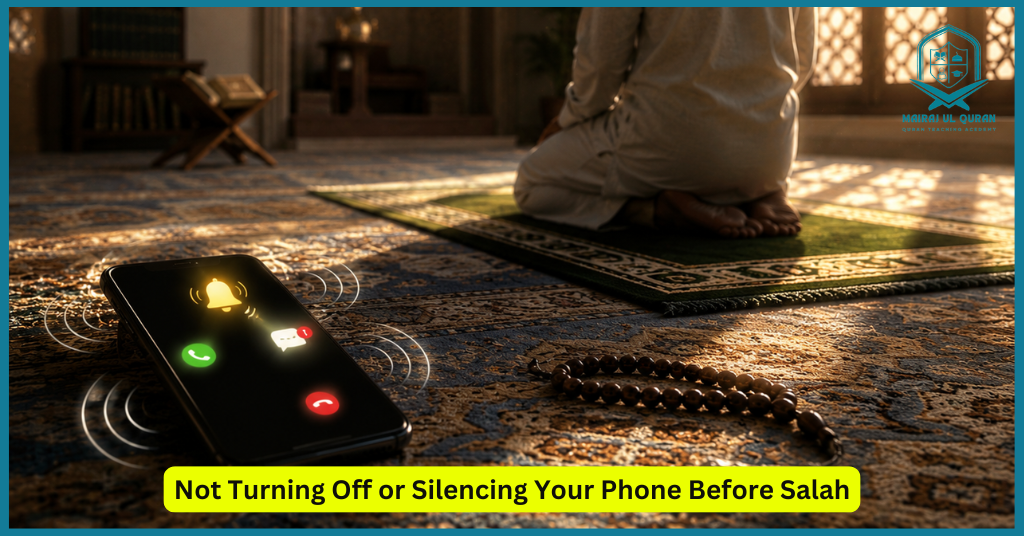
This is a very modern mistake, but an extremely common one. A phone ringing loudly during Salah, notification sounds going off, music accidentally playing, or even glancing at a screen mid-prayer all break your concentration, and can distract the people around you too.
To be clear, this isn’t about treating your phone as something sinful. It’s simply a practical reminder that a small habit, silencing your phone before you start, can save you and everyone around you from an unnecessary distraction.
How to fix: Build a simple habit around it, the same way you take off your shoes before entering the prayer area. A good time to silence your phone is right there at the shoe rack, before you even step inside. That way, by the time you’re standing for Salah, it’s already done, and you’re not fumbling with your phone while everyone else is already praying.
Number 7. Crossing in Front of Someone Who Is Praying
Walking directly in front of someone while they’re praying is something many people don’t realise is actually discouraged, and quite seriously so. The space directly in front of a person praying is meant to be respected.
This isn’t just a cultural habit, it comes from a clear and authentic hadith. The Prophet ﷺ said: (Sahih al-Bukhari 510)
“If the one who passes in front of a person who is praying knew what a burden of sin he bears, he would prefer to stand still for forty [days, months, or years] rather than pass in front of him.”
This connects to the concept of Sutrah, a physical marker like a wall, pillar, or object placed in front of a person praying, which shows others where not to walk. If you’re praying somewhere without a clear Sutrah, it’s worth being mindful of the space in front of you, and if someone tries to walk through it, you’re allowed to gently signal them to go around instead.
Simple fix: If possible, pray with something in front of you as a Sutrah, and if you see someone about to walk through your prayer space, a small hand gesture is enough to ask them to walk around.
Other Common Salah Mistakes Muslims Should Know

Beyond the seven mistakes above, there are a few smaller but still important habits worth being aware of.
Not Making Proper Wudu
Rushing through Wudu, missing a required part, or not washing properly can affect the validity of the Salah that follows it. If you’re ever unsure about a specific Wudu situation, we’ve covered this in detail in our article on reading the Quran without Wudu.
Praying Without Facing the Qiblah When Able
Whenever possible, facing the Qiblah correctly is an important part of a valid Salah. This becomes more flexible in situations like travel, but shouldn’t be ignored out of simple carelessness.
Incorrect Pronunciation in Quran Recitation
Mispronouncing words during Salah, especially in a way that changes the meaning, is a mistake worth taking seriously and correcting with proper Tajweed learning.
Forgetting the Required Parts of Salah
Missing an essential part of the prayer, even by accident, is a common issue for beginners still learning the correct structure.
Excessive Unnecessary Movement
A small, occasional movement, like adjusting clothing, isn’t a problem. But constant, unnecessary movement throughout the prayer can take away from focus and, in some cases, affect the prayer itself. There’s a real difference between necessary movement (adjusting for comfort or need), normal minor movement, and excessive movement that shows a lack of attentiveness.
Not Straightening the Rows in Congregational Prayer
Leaving gaps between shoulders in congregational prayer, instead of standing close and straight, is a small habit many people overlook.
Becoming Distracted by Clothes, Hair or Objects
Fidgeting with clothing, hair, or nearby objects during Salah is a common but avoidable distraction.
Not Giving Proper Attention to Khushu
Khushu means having real focus and humility during Salah, rather than just going through the physical motions. This is often the hardest thing to maintain, and also the most valuable.
How to Improve Your Salah Step by Step
Improving Salah doesn’t happen overnight, but small, consistent steps make a real difference over time.
Learn the Correct Method of Salah
Start with the basics done right, the correct order, positions, and words, so everything else builds on a solid foundation.If you want to understand what Salah really means and why it’s so important, we’ve explained it fully in our article on the importance of Salah in Islam.
Learn the Meaning of What You Recite
Understanding what you’re actually saying in Salah naturally brings more focus and connection to the prayer.
Improve Your Quran Pronunciation
Correct Tajweed makes your recitation accurate and helps you feel more confident in your Salah.
Slow Down Your Movements
Give each position, standing, Ruku, Sujood, sitting, its proper time, rather than rushing through the motions.
Remove Distractions Before Salah
Turn off or silence your phone, find a quiet spot if you can, and take a moment to calm your mind before you start. If you’re praying at the mosque, it also helps to know the proper mosque etiquette and manners, since a few small habits there really do make a difference.
Ask a Qualified Teacher When You Are Unsure
If something about your Salah doesn’t feel right, or you’re unsure about a rule, ask someone who actually knows, rather than guessing or assuming. If you don’t have a scholar or teacher nearby to ask, our team at Mairaj Ul Quran is always happy to guide you or point you toward the right answer, just reach out and ask.
How Parents Can Teach Children to Avoid Salah Mistakes
Teaching kids Salah the right way from the start makes a huge difference later on. A few simple approaches that help:
- Teach Salah gradually, one part at a time, rather than expecting a child to get everything right immediately
- Demonstrate the movements yourself so your child can see, not just hear, how it’s done
- Correct children gently, without frustration, when they get something wrong
- Teach the meaning of basic duas, so Salah feels meaningful, not just memorised words
- Practice together as a family, so it becomes a normal part of daily life
- Avoid embarrassing children in front of others when they make a mistake, correct them privately and kindly
- Encourage consistency over perfection, a child who prays regularly, even imperfectly, is building a lifelong habit
Conclusion
Small mistakes in Salah are common, and almost every Muslim picks up a few habits over the years without realising it. The good news is, becoming aware of them is most of the battle. Slowing down, staying present, and correcting these small habits one at a time can genuinely transform how your Salah feels, and bring you closer to the real Khushu.
If you’d like guided help improving your Quran recitation, Tajweed, or overall Islamic learning, the team at Mairaj Ul Quran is here to support you, one step at a time.