
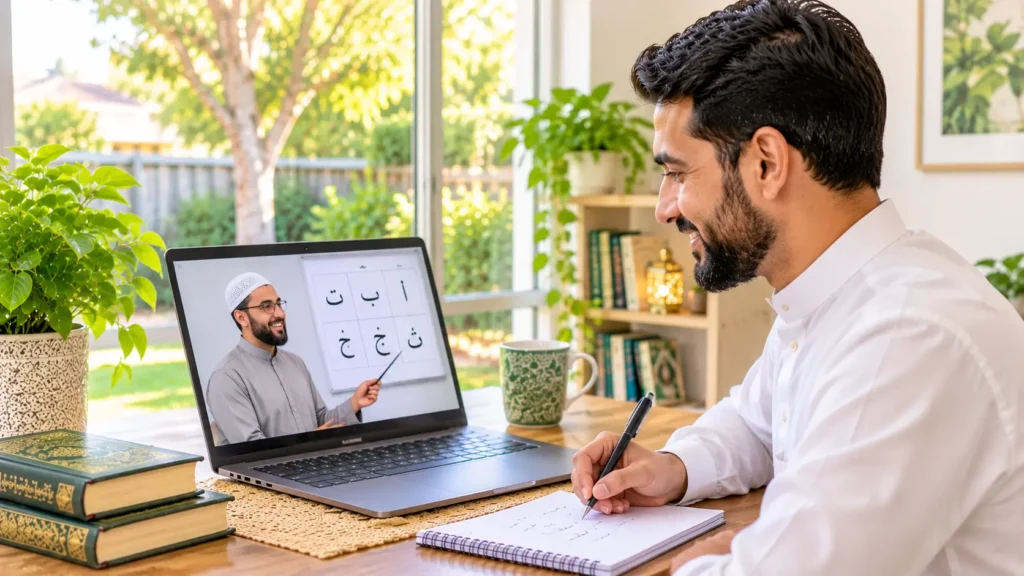
To learn the Arabic alphabet for beginners, start with the 28 letters, learn their sounds, then practise how they join in words, which most learners can begin to do within a few weeks of regular practice. Arabic is written from right to left, and once you know the letters, short vowels and joining rules, you have the foundation for reading the Quran.
This guide is written for Australian learners: parents whose children are starting school, adults who never had the chance to learn, and new Muslims beginning their journey. You will find every letter with a sound tip, the sounds that English speakers find tricky, a simple four week plan and ideas for fitting practice around school, work and shift life.
How Many Letters Are in the Arabic Alphabet?
The Arabic alphabet has 28 letters, and every letter is a consonant or a long vowel sound.
Arabic is written and read from right to left. Most letters change shape slightly depending on whether they sit at the start, middle or end of a word, or stand alone. The good news is that the shapes are built from a small set of basic forms, so many letters look alike apart from the dots.
What Are the 28 Arabic Letters and How Do They Sound?
Here is every letter with its name and a simple sound guide. A teacher will correct the exact pronunciation, because some sounds do not exist in English.
| Letter | Name | Sound guide |
|---|---|---|
| ا | Alif | Long “a” sound, or a carrier for other vowels |
| ب | Ba | “b” as in bat |
| ت | Ta | “t” as in tap |
| ث | Tha | “th” as in think |
| ج | Jim | “j” as in jam |
| ح | Ha | A breathy “h” from the throat, with no English match |
| خ | Kha | Like the “ch” in Scottish loch |
| د | Dal | “d” as in door |
| ذ | Dhal | “th” as in this |
| ر | Ra | A rolled “r” |
| ز | Zay | “z” as in zoo |
| س | Sin | “s” as in sun |
| ش | Shin | “sh” as in ship |
| ص | Sad | A heavy, deep “s” |
| ض | Dad | A heavy, deep “d” |
| ط | Ta (heavy) | A heavy, deep “t” |
| ظ | Zha | A heavy “th” as in this |
| ع | Ayn | A deep throat sound with no English match |
| غ | Ghayn | Like a gargled “r”, close to the French “r” |
| ف | Fa | “f” as in fan |
| ق | Qaf | A deep “k” from the back of the throat |
| ك | Kaf | “k” as in kite |
| ل | Lam | “l” as in lamp |
| م | Mim | “m” as in moon |
| ن | Nun | “n” as in nut |
| ه | Ha (soft) | A soft “h” as in hat |
| و | Waw | “w” as in water, or a long “oo” |
| ي | Ya | “y” as in yes, or a long “ee” |
Which Arabic Sounds Are Hardest for English Speakers?
The hardest sounds for English speakers are the throat letters and the heavy letters, because English has no direct match for them.
- Throat letters: ح (Ha), ع (Ayn), خ (Kha) and غ (Ghayn) come from the throat and are the hardest to hear and copy
- Heavy letters: ص, ض, ط and ظ are pronounced with a fuller, deeper mouth than their lighter partners س, د, ت and ذ
- Qaf and Kaf: ق comes from deeper in the throat than ك, and mixing them changes the meaning of a word
- The rolled R: Australian English uses a soft “r”, but Arabic ر is rolled lightly with the tip of the tongue
Many Australian learners already speak Urdu, Hindi, Bengali, Persian or Turkish at home. If that is you, you may already know the shapes of many letters, since several of these languages use a similar script. The challenge is usually the pronunciation, which is why a live teacher who can hear your sounds makes a big difference. Our Noorani Qaida course is built around exactly this.
How Do Arabic Letters Join Together?
Arabic letters join to the next letter on their left, except for six letters that never join forward.
Most letters have four forms: on their own, at the start of a word, in the middle and at the end. The six letters that do not join to the next letter are ا, د, ذ, ر, ز and و. When one of these appears, the next letter starts fresh, which is why words can look slightly broken. Practising short words with a teacher helps you see these patterns quickly.
What Are the Arabic Vowel Marks?
Arabic has three short vowels, shown by small marks above or below the letter, and long vowels shown by ا, و and ي.
- Fatha: A small slanted line above the letter, sounding like a short “a”
- Kasra: A small slanted line below the letter, sounding like a short “i”
- Damma: A small curl above the letter, sounding like a short “u”
- Sukoon: A small circle that tells you the letter has no vowel
- Shaddah: A small mark that doubles a letter
- Tanween: A double mark that adds an “n” sound at the end of a word
The Quran is written with these marks, so learning them is a necessary step before you read. They are the next chapter in the Noorani Qaida and lead straight into Quran recitation.
What Is a Simple 4 Week Plan to Learn the Arabic Alphabet?
A simple plan is to learn a few letters at a time, practise a little each day and add the vowel marks once the letters feel familiar.
This is a suggested guide, not a promise, because every learner moves at a different pace.
- Week 1: Learn the first 10 letters and their sounds. Practise saying them aloud and tracing them
- Week 2: Learn the next 10 letters, including the throat letters. Revise week one every day
- Week 3: Learn the final 8 letters and start to see how letters join into short words
- Week 4: Add the short vowels and practise reading simple syllables and words
Ten to fifteen minutes a day is enough to begin. A tutor will adjust the plan to your pace, and you can see how lessons are structured on our courses page.
How Can You Fit Arabic Practice Into Australian Life?
You can fit practice into your day by using short, regular sessions around school terms, work shifts and the commute.
- For school children: Prep to Year 2 children do well with 10 minute sessions after school, and our online Quran classes for kids Australia are built around the school year
- For adults and shift workers: Early mornings, lunch breaks or after Isha work well, and lesson times are booked in your local time
- For school holidays: Use the holidays to add extra practice and revise what you have learnt
- Before Ramadan: Start two or three months early, so you can read confidently by the first taraweeh
Lessons are booked in your local time, and we adjust your slot when daylight saving starts or ends. Queensland, the Northern Territory and Western Australia do not change their clocks. You can see how this works in your city on our areas we serve page, or read about lessons in Sydney, Melbourne, Brisbane and Perth.
Should You Learn the Arabic Alphabet With a Teacher or an App?
A teacher is the better choice for the alphabet, because pronunciation needs live correction that apps cannot provide.
Apps and videos are useful for revision, but they cannot hear your mistakes. Without correction, wrong sounds can become habits. A live tutor listens, corrects gently and adjusts the lesson to your pace. If you are a complete beginner, private lessons also remove the embarrassment of learning in front of others. Many of our students are adults who start from scratch, and our guide for new Muslims explains how to begin with confidence.
What Should You Learn After the Arabic Alphabet?
After the alphabet and vowel marks, you should learn to read words and verses, then Tajweed, and later memorisation and meaning.
- Reading words and short verses: Move on to Quran recitation
- Pronunciation rules: Study the rules of Tajweed
- Daily duas and prayer words: Learn short supplications from our Masnoon Duain page and our Salah lesson
- Memorisation: Begin Quran memorisation once you can read well
- Meaning: Add Quran translation and later Tafseer
For children, you can combine reading with Islamic Studies for Kids and Daily Duas for Kids. If you are thinking about memorisation, read our guide to the best age to start Hifz for children in Australia.
What Mistakes Do Beginners Make When Learning Arabic Letters?
The most common mistakes are rushing, ignoring the throat letters and not practising out loud.
- Rushing through letters: Learn a few at a time and revise often
- Treating similar letters as the same: ث, س and ص sound different, as do ت, ط and د
- Learning only from screens: Say each letter aloud and trace it by hand
- Skipping the vowels: Letters alone do not let you read
- Giving up too early: The throat sounds take weeks, not days
Our library has free resources to support your practice between lessons.
Learn the Arabic Alphabet for Beginners: Frequently Asked Questions
How long does it take to learn the Arabic alphabet?
Many beginners can learn all 28 letters in a few weeks with daily practice, but how long it takes depends on age, time and practice. Reading words fluently takes longer, and a tutor will set a realistic pace for you.
Is Arabic hard for English speakers to learn to read?
Arabic letters are not hard to learn, but some sounds are new to English speakers. The throat letters and the heavy letters take the most practice. A live teacher who can hear and correct your pronunciation makes these much easier.
Can adults in Australia learn the Arabic alphabet from scratch?
Yes, adults can learn the Arabic alphabet from scratch, and many Australian adults do. Private lessons mean you can learn at your own pace without feeling embarrassed, and you can book around work and family.
What age can children start learning Arabic letters?
Many children can start around five or six, when they can sit for a short lesson. Younger children can listen and play with letters first. Short sessions and plenty of repetition work best.
Do I need to learn the Arabic alphabet before reading the Quran?
Yes, you need to know the letters, sounds and vowel marks before you can read the Quran correctly. This is why most learners begin with Noorani Qaida and then move on to recitation.
Is there a free trial for Arabic alphabet lessons?
Yes, every new student gets a free 3 day trial with a real tutor, and no payment is needed. Your tutor will find your level and suggest a plan. You can see our fee structure or contact us to book.
Ready to begin? Book a free trial with Mairaj Ul Quran, one of the online Quran classes Australia families trust, and let a certified tutor guide you from your first letter.